Black Mirror's Black Museum Is the Most Disturbing Episode in the Series. We Had to Talk About It.

Updated: May 7
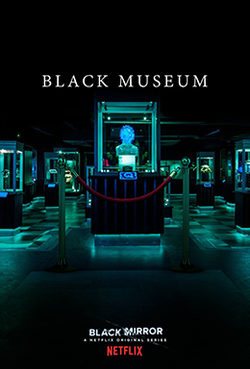
If you have ever wanted to watch a television episode that makes you genuinely reconsider humanity's capacity for cruelty, and then pours you a glass and says, yeah, but what if it got worse, Black Museum is the one. It is the Season 4 finale of Black Mirror, it runs just over an hour, and by the time it was over, we were all sitting with that particular kind of silence that only the best horror produces. Not jump-scare silence. Processing silence.
This is Fear & Wine, and Kelli brought in the heavy artillery.
First, a Note for the Uninitiated
Leah and Alisan had not seen much Black Mirror going into this one, and honestly, that made for one of the more interesting conversations we have had on the podcast. Watching someone encounter this show for the first time, and specifically this episode, is its own kind of experience. There is a moment where you can see the shift happen in real time, where it stops being weird sci-fi and starts being something that sits under your skin.
For anyone else coming in fresh: Black Mirror is a British anthology series, which means every episode is a completely standalone story. Different cast, different world, different nightmare. You do not need to have seen anything else to watch Black Museum. But fair warning: this is not a starter episode. Kelli has a whole list of gentler entry points if you need them. This one goes straight for the throat.
What Black Museum Actually Is
Black Museum is structured as a frame story. A young woman named Nish stops at a remote roadside museum in the American desert while her car charges. The museum is run by a man named Rolo Haynes, who has a collection of artifacts from notorious crimes involving technology, each one with a story attached. He is delighted to tell her all of them. He is that guy. You know the type.
What follows is three nested stories, each one escalating in horror, and each one connected to the others in ways that only become clear at the end. It is intricate, it is brutal, and it is one of the most carefully constructed hours of television the show has ever produced.
Story One: The Doctor Who Felt Too Much
The first story follows a doctor who gets access to experimental technology that allows him to experience his patients' pain directly. The idea is that feeling what they feel will make him a better diagnostician. And it does, for a while. The problem is that pain starts to feel good. Not metaphorically. The technology rewires something in his brain and the sensation of pain becomes pleasurable, which escalates in ways that are genuinely hard to watch and impossible to look away from.
This one is based on a Penn Jillette short story called "The Pain Addict," and it shows. There is a dark comedic undercurrent running through it that makes the horror land harder. By the time it ends you are already uneasy and Rolo has barely gotten started.
Story Two: The Husband in the Headset
The second story is where the episode shifts from horror-with-dark-humor into something genuinely devastating. A man's consciousness is transferred into his wife's mind after a coma — they develop a way for her to experience his presence as a co-pilot in her own body. At first it works. Then it stops working, in one of the most quietly brutal depictions of a relationship dissolving that the show has ever done. What happens to him after that is the kind of thing you think about at 2 AM for no reason, weeks later.
Leah, who had come into this episode relatively composed, had some thoughts here. That is probably as specific as we should get. Listen to the episode.
Story Three: The Main Attraction
This is where Black Museum becomes something else entirely. The centerpiece of Rolo's collection is a man, or what remains of a man, named Clayton Leigh, a death row inmate whose consciousness was copied at the moment of his execution and now exists in a loop inside a miniature figure in a glass case. Visitors can press a button and experience his death. Rolo sells the experience as entertainment. He has been doing it for years.
This is the part of the episode where the show's willingness to engage directly with the history of racialized violence in America becomes impossible to ignore. Clayton is Black. The people paying to experience his suffering are not. The framing is not subtle, and it is not meant to be. Black Mirror creator Charlie Brooker has said this episode is partly a response to the long tradition of horror that treats Black pain as spectacle, and that awareness is baked into every frame of this story.
It is also where Nish's real reason for being there becomes clear, and where the episode stops being a collection of dark stories and becomes something with genuine moral weight and in its own savage way, something close to justice.
The Ending
We are not going to spoil the ending here in full, but we will say this: it is one of the most satisfying conclusions in the entire series. Nish is not who she appears to be, and the way that reveal recontextualizes everything that came before it is exactly the kind of move Black Mirror does better than almost any other show on television. The final image is cold and perfect and we were absolutely feral about it.
Kelli had been waiting to talk about this episode for a while. It showed.
What We Actually Talked About
Beyond the plot breakdown, we got into the question of what makes something horror versus what makes it tragedy, because Black Museum is doing both at once and the line keeps shifting. We talked about technology as a vehicle for the worst impulses people already have, which is the thesis of the entire show distilled into one episode. We talked about what it means to put suffering on display, who gets to profit from it, and who never does. And then we talked about the wine, because that is how we cope.
What Makes This One of the Best Black Mirror Episodes
Most Black Mirror episodes pick a lane: bleak cautionary tale, love story gone wrong, social satire with teeth. Black Museum refuses to pick one. It is a horror anthology within a horror anthology. It is formally ambitious in a way the show does not always attempt. And it has something to say that it actually commits to saying, which is rarer than it should be.
The performances are exceptional, particularly Letitia Wright as Nish, who carries the entire episode on her back and makes the ending land the way it needs to. If you have not seen this one, it is essential viewing. If you have seen it, you already know exactly why we had to cover it.
Wine Pairing: Black Cloud Red Blend by Cloud Break
A dark, full-bodied red for an episode that earns every drop. Something with enough weight to sit with you through all three stories and still be standing at the end. Cloud Break's Black Cloud Red Blend was exactly right for this one: complex, a little ominous, and it finishes smooth. Just like the episode does not.
Listen to the Episode
We covered Black Museum in full on Fear & Wine: all three stories, the ending, and the conversation that followed. These are two of the most unsettling hours of television Black Mirror has produced and we did not hold back. Come find us wherever you listen.
Comments