The Best Horror Film in Theaters Right Now Cost $1 Million and We Cannot Stop Thinking About It
Updated: May 27
Remember the social media debate about whether being trapped in the woods with a man or bear would be safer for a woman? Curry Barker's "Obsession" shows women it is BOTH

There is a horror film in theaters right now that cost one million dollars to make and sold at the Toronto Film Festival for over fifteen million. It was written and directed by a twenty-six-year-old YouTube comedian. It stars two people you probably do not know yet. And it is one of the best horror films we have seen in years.
It is called Obsession. The director is Curry Barker. And if you have not seen it yet, stop reading this, go to the theater, and come back when you are done. Everything below is a full spoiler breakdown and it earns every word.
What Obsession Is About (On the Surface)
Bear, full name Baron Bailey, is a shy music store employee in love with his childhood friend and coworker Nikki Freeman. He has been in love with her for years. He cannot tell her. One day he overhears Nikki mention she dropped her crystal necklace down a sewer drain, and because he has catalogued every detail of her existence the way people who cannot confess their feelings tend to do, he goes to the local New Age shop to buy her a replacement.
The shop does not have the right necklace. But on the shelf, Bear spots something called the One Wish Willow. A small boxed novelty toy from the 1960s. Discontinued. Six dollars and ninety-nine cents. Instructions simple: snap the branch in half, make one wish, the wish comes true. One wish only. Cannot be reversed or repeated. The disinterested store clerk mentions that some customers have come back to complain. Bear asks if that means it did not work. The clerk says: or because it did. Or they die. Or wish they did.

Bear buys it anyway.
That night, after a group trivia outing where he fails to say a single meaningful thing to Nikki, Bear drives her home. She walks him to her door. She looks him in the face and asks him directly: do you like me? Now is the time to say it. He says no. She goes inside. And Bear, standing alone in her driveway, snaps the One Wish Willow in half and says: I wish Nikki Freeman would love me more than anyone else in the world.
Nikki reappears on the porch within seconds. And something has already changed.
Freaky Nikki vs. Real Nikki: The Moral Core of the Film
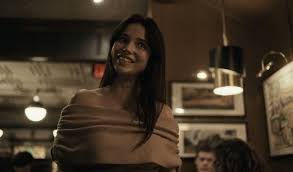
From the moment the wish is made, there are two Nikkis. There is Real Nikki, the person we met in the first act: warm, funny, autonomous, a woman going about her own life who did not ask to be wished at. And there is Freaky Nikki, the entity the wish created, which is not a person at all. It is a compulsion wearing Nikki's face. It exists only to keep Bear close. It does not sleep. It does not eat normally. It has no wants beyond him.
Freaky Nikki, by the way, is what Bear used to call her as a joke nickname. She hated it. It has now become horrifyingly literal.
Real Nikki is still in there. She surfaces in windows when the entity is dormant, usually in the middle of the night, and in those moments she is lucid and terrified. She whispers to Bear that the other version of her is asleep and she does not have much time. She begs him to kill her. She says she cannot keep living like this. Please.
Bear cannot do it.
This is the moral center of the film. Not the screaming. Not the violence. The fact that a woman is conscious and trapped inside her own body, surfacing to ask for help, and getting none. Real Nikki is aware of everything being done with her body. She did not consent to any of it. The wish removed her bodily autonomy entirely and handed it to Bear, and Bear did not ask for that explicitly, but he did ask for her love without her consent, and this is what unconsented love looks like when you follow it all the way to its logical end.
The Scenes That Will Stay With You
The morning after Nikki first comes home with Bear, he wakes up to find she has duct-taped the entire front door shut. Floor to ceiling. She hands him a packed lunchbox, smiling. And then, at the end of the day when Bear comes home, Nikki is standing in the same spot she was when he left. Freaky Nikki wets herself. Right there. While he watches. She has been standing at that door all day. She did not rest. She did not move. Because Freaky Nikki does not have needs. Freaky Nikki just has Bear.
The lunchbox matters. Bear had mentioned in passing that he always wanted to be a food critic. Freaky Nikki remembered. Inside the lunchbox is a sandwich, and a note that says: how is the verdict, cat? Bear's cat Sandy had died at the beginning of the film, found in Bear's pill drawer having gotten into his grandmother's old prescription stash. Bear lifts the bread of the sandwich. Sandy's paw is inside it.
At TIFF, the theater handed out actual sandwiches to the audience before this scene. Simultaneous gagging was reported. This tracks.
After the sandwich, Bear calls the One Wish Willow customer service number. The rep is polite and very clear: the wish cannot be altered or undone. It ends only when the wisher dies. The rep then puts someone else on the line. It is Real Nikki. Screaming. That is the full customer service experience.
Bear, the Nice Guy, and the Film's Real Thesis
Obsession is being discussed online as a horror film about the incel archetype, the "nice guy" who believes his decency entitles him to a woman's love, and that reading is accurate and important. But the film is doing something more precise than that. Bear is not a monster in the traditional sense. He is horrified by what is happening to Nikki. He does not want her to suffer. He tries to reverse the wish. He fails. He eventually decides the only solution is his own death.
What makes Bear so disturbing is not that he is evil. It is that he is ordinary. He is the kind of person who gets a crush, cannot express it, convinces himself the feelings he has built up entitle him to something, and when he finally acts, he does it in a way that removes her agency entirely rather than risking her rejection. The One Wish Willow did not corrupt a pure love. It gave him exactly what he asked for. He asked for her love without her consent. And the horror is what unconsented love looks like when it is made literal.
The film keeps you in Bear's point of view the entire time. You are never inside Nikki's head. You only ever see what Bear sees. Which means every time Bear does not act, every time he knows something is wrong and keeps going anyway, you are sitting right there with him. The film implicates the audience in his passivity. That formal choice is the most disturbing thing in a film full of disturbing things.
The Friend Group and the Billion Dollars
Bear's friends are worth discussing. Sarah, played by Megan Lawless, is the boss's daughter, sweet and a little self-serving, with a quiet thing for Bear that nobody is addressing. She is killed by Freaky Nikki after Freaky Nikki sees her and Bear together in a car. They are not doing anything. It does not matter. Freaky Nikki does not tolerate competition. Sarah did nothing wrong. Sarah is dead because Bear made a wish in a driveway instead of saying two sentences out loud.
Ian, played by Cooper Tomlinson (who is Curry Barker's real-life comedy partner), is Bear's best friend and the most honest person in the film. When Bear, desperate, gives Ian one of his unbreakable Willows and begs him to wish the curse away, Ian wishes for a billion dollars. It rains down immediately outside the window. Ian is thrilled. Ian is dead shortly afterward. The billion dollars, Curry Barker confirmed in an interview, did not disappear when Ian died. It is still somewhere in that house.
Andy Richter plays Sarah's dad and the boss at the music store. His casting is a deliberate tonal signal. When you hire a beloved late night comedy sideman and put him in your horror film, you are telling the audience: we know where you think this is going. We are going somewhere else.
The Ending and the Alternate Ending We Almost Got
Bear locks himself in the bathroom with his grandmother's pill stash and a gun. He knows the only way to break the wish is his death. He picks up the gun. He cannot use it. He takes the pills instead and sits on the bathroom floor to wait.
From the other room, we hear the One Wish Willow jingle. The little chime it makes when the branch snaps. Nikki has found one of Bear's unbreakable Willows, and she broke it. The film strongly implies she wished for the mirror of Bear's original wish: that he would love her more than anyone else in the world. Bear walks out of the bathroom calm and soft and holds her. They sit together on the couch in the wreckage of everything, finally mutually consumed by each other. And then the pills kick in.
Bear dies in Nikki's arms. When he dies, the wish dies with him. Freaky Nikki is gone. Real Nikki comes back. She is covered in blood, surrounded by bodies, holding a dead man, with no memory of anything her body did while the entity had control of it. She pushes Bear away and cries. Not because she loved him. Because she finally understands the full shape of what was done to her.
The original ending had Nikki die too. Barker said he only gave Navarrette one take of the survival ending, told her it probably would not make it into the film, and asked her to just do whatever felt true. What she did is what you see in the theater. Barker said it was so raw that everyone around him talked him into using it. Survival, he noted, might actually be the crueler choice. Because now you have to ask: now what.
Inde Navarrette and the Performance That Defines This Film

Inde Navarrette plays both Nikkis. She built the physicality from scratch with Barker on set over twenty-six days on an indie budget with no references. The movement, the voice, the switching between states, the way Real Nikki surfaces in the cracks of Freaky Nikki's performance and you can see someone drowning inside their own body. None of it existed before she invented it.
Curry Barker said in an interview that he was genuinely freaked out by her performance on set. He wrote the film. He directed the film. She scared him. Multiple critics have reached for Linda Blair. The Rotten Tomatoes audience is already talking about an Oscar nomination. We are not going to argue with any of that.

Michael Johnston as Bear has the harder role in some ways, playing a character the audience grows to despise while keeping just enough humanity that you never fully stop understanding him. It is a very controlled performance in a film dominated by a very uncontrolled one, and the contrast is exactly right.
Curry Barker and the Comedy-to-Horror Pipeline
Before Obsession, Curry Barker was known as half of the YouTube sketch comedy duo "That's a Bad Idea," alongside Cooper Tomlinson. Their videos center on socially awkward situations that escalate past the point of no return. That is also the exact description of Obsession. Jordan Peele came from Key and Peele. Zach Cregger came from sketch comedy. The Philippou brothers came from YouTube. There is a structural reason comedians keep making excellent horror films: good sketch comedy and good horror share the same mechanism. Both are about timing. Both rely on expectations being set up and then detonated.
Barker already has his next film greenlit before Obsession even opened wide. It is called Anything but Ghosts, produced by Jason Blum and Roy Lee through Blumhouse and Spooky Pictures, distributed by Focus Features. The industry moved on this filmmaker at a speed that almost never happens for a second feature.
The One Wish Willow Marketing Campaign Is Part of the Horror
Focus Features built an entire in-world product website at OneWishWillow.com where you can actually buy a collectible replica One Wish Willow for six dollars and ninety-nine cents. They produced a vintage-style infomercial for it that sold out twice on launch and racked up millions of YouTube views. In Los Angeles and New York, cryptic billboards went up. Fans who interacted with those billboards began receiving texts, voice notes, and packages from a character named Nikki. People were getting messages from a possessed woman on their personal phones while they were at work.
A film about non-consensual love used a marketing campaign that reached into people's private phones uninvited. Whether that is thematically pointed or just very clever advertising is a question worth sitting with.

A note from us directly: we loved this film enough to slide into Curry Barker's Instagram DMs on May 16th. We told him we loved it, and we had one burning question: what was the prompt on Nikki's Jenga block that resulted in her Hansel and Gretel monologue? Curry has 159,000 followers, a verified checkmark, and the mutual bond of both following Nathan Fielder. He did not respond. Curry, the question stands. Come on the podcast.
Listen to the Episode
We will cover Obsession in full on Fear and Wine, scene by scene, with all four of us in the room. The villain debate, the bodily autonomy conversation, the billion dollars, the ending. All of it. Find us wherever you get your podcasts.
The episode will release soon... in the meantime:
If this is your first time here, we are a horror podcast that pairs every film and show with wine, takes the content seriously, and does not take ourselves too seriously. Pull up a glass.
Obsession is rated R and currently playing in theaters nationwide.
Runtime 109 minutes.
Directed by Curry Barker.
Distributed by Focus Features and Blumhouse Productions
Comments