The Cahill Thread: What a Classified Defense Researcher's Name Is Doing in a UFO Drawing's Metadata

Updated: 4 days ago
A retired Air Force general vanishes. A drawing surfaces on a UFO reporting database. Buried inside its hidden file data is the name of a man who spent thirty years building laser weapons technology for the U.S. military. We pulled the thread.
FEAR AND WINE | Kristin | August 2026 | Limitations on Nature Series

In February 2026, retired U.S. Air Force Major General William Neil McCasland disappeared from his home in Albuquerque, New Mexico. He walked out while his wife was at a medical appointment, left his phone and glasses behind, and has not been found. McCasland was the 7th Commander of the Air Force Research Laboratory at Wright-Patterson Air Force Base in Ohio. In leaked emails made public years earlier, musician and UFO disclosure advocate Tom DeLonge described McCasland as someone who was "very, very aware" of classified materials relating to unidentified aerial phenomena.

Since his disappearance, researchers tracking the case have focused on a social media account on X, formerly Twitter, called @TMBSPACESHIPS. The account, widely attributed to McCasland by independent investigators, posted thousands of times about electric field propulsion, plasma physics, and what the account described as the operating principles of classified transmedium vehicles.
The Metadata Find

Among the images associated with the @TMBSPACESHIPS account is a hand-drawn illustration of a spherical craft. The drawing depicts an object observed at Lake Belton, Texas in August 1991. It was posted to the @TMBSPACESHIPS account and separately submitted to NUFORC, the National UFO Reporting Center, as part of an anonymous sighting report.
A researcher in the r/UFOB community ran the NUFORC-hosted version of that image through an EXIF metadata viewer. EXIF data is information embedded in digital image files, including when a file was created and who created it. Social media platforms strip this data automatically. NUFORC does not.
What the EXIF data contained:
Artist: Paul Cahill
Creator: Paul Cahill
Copyright: Paul Cahill
File created: November 22, 2022
Location: None embedded
The researcher confirmed that other NUFORC images do not carry this artist and creator field structure. It is not a platform default. Paul Cahill's name was present in the file at the time of upload. The alleged sighting was in 1991. The digital file carrying his name was created or last modified in November 2022, during the active operational period of @TMBSPACESHIPS on X.
So who is Paul Cahill?
A Career Built Inside Classified Defense Research

Paul A. Cahill holds a PhD in chemistry from the University of Illinois at Urbana-Champaign. From 1986 to 1998, he was a Senior Member of Technical Staff at Sandia National Laboratories in Albuquerque, New Mexico, assigned to Division 1811, the organic materials chemistry group. Sandia is not a civilian research institution. It is headquartered at Kirtland Air Force Base and is a U.S. Department of Energy national security laboratory whose work encompasses nuclear weapons components and classified defense applications. Cahill's documented research focus there was polymers, nonlinear optics, and electronic materials.
In 1998, Cahill moved to Dayton, Ohio to become Vice President of Research and Development at Exciton Incorporated, a company that has manufactured laser dyes since 1972. His LinkedIn profile describes his Exciton role as "R&D, Air Force contract research, SME for LEP." SME is Subject Matter Expert. LEP is Laser Eye Protection. For nineteen years, he was the Air Force's subject matter expert on the materials used to protect military pilots' eyes from laser threats, doing classified contract research in Dayton, home of Wright-Patterson Air Force Base.
1986-1998 | Sandia National Labs / Kirtland AFB, Albuquerque, NM. Division 1811. Nonlinear optical polymer research for classified defense applications. |
1998-2017 | Exciton Inc., Dayton, OH. VP of R&D. Air Force contract research. Subject Matter Expert, Laser Eye Protection. |
2011-2013 | Cahill's Air Force LEP contract period overlaps with Neil McCasland's command of AFRL at Wright-Patterson. Same city, same institutional ecosystem. |
Exciton held at least one Small Business Innovation Research contract for military laser eye protection work. A SBIR award abstract confirmed the company demonstrated that its laser protection dyes could be embedded in soft contact lenses to protect warfighter vision from laser threats. Exciton's materials were also used in polycarbonate military pilot visors and aircrew spectacles, products developed in direct coordination with Air Force Research Laboratory requirements.
The Co-Author Network
Cahill's published research record reveals something beyond his Sandia affiliation. In 1995, he co-edited a volume published by the American Chemical Society, titled "Polymers for Second-Order Nonlinear Optics." His co-editor was Geoffrey A. Lindsay, whose institutional affiliation is listed in the volume as: U.S. Navy, Code 474220D, NAWCWPNS, China Lake, California.
NAWCWPNS is the Naval Air Warfare Center Weapons Division at China Lake. China Lake is where the Navy develops directed energy weapons, hypersonic systems, and advanced propulsion technology. In a 1991 technical report archived through NASA's technical reports server, Lindsay stated the objectives of his own research program explicitly. His polymer work was targeted at, in his words, "applications for missile systems involving signal modulation and laser beam deflection" and "sensor protection against lasers." The research was sponsored by the Office of Naval Research.
The same 1995 ACS volume lists additional contributors from the U.S. Army Missile Command at Redstone Arsenal and the Naval Air Warfare Center at Warminster, Pennsylvania. The network Cahill published within was not an academic collaboration. It was a documented multi-service classified defense research program, spanning the Navy's weapons development at China Lake, the Army's missile command at Redstone, and the Air Force's materials research ecosystem in Dayton.
Analytical Frame Paul A. Cahill's documented career places him at the center of a multi-service classified defense research network focused on optical materials, laser protection systems, and directed energy applications. His co-authors were embedded at Naval weapons development, Army missile command, and Naval aircraft survivability programs. His employer from 1998 to 2017 held Air Force contracts in the exact technological category that McCasland's AFRL command directorate funded and oversaw. Their documented professional worlds overlap in geography, institution, and subject matter during the same years.
The Drawing's Three Anomalies
The Lake Belton drawing is not a typical NUFORC submission. Three features of the document stand out when examined closely.
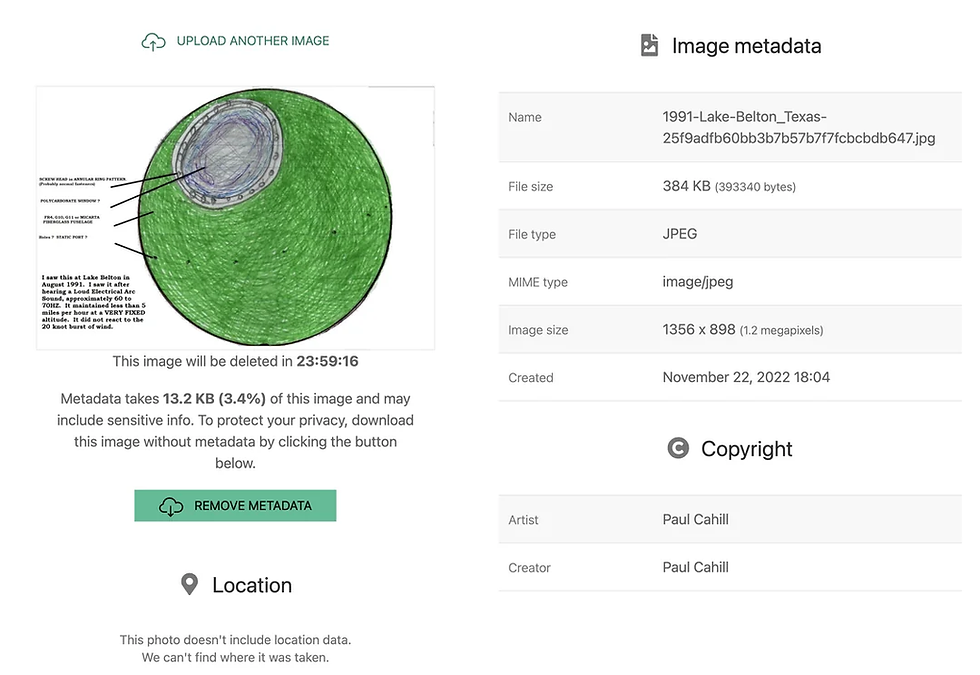
The first is the annotation language. The craft is labeled using specific material trade designations: G10, G11, and MICARTA fiberglass, which are glass-epoxy laminates and phenolic composites used in aerospace and electronics manufacturing. The window is labeled as polycarbonate. The type of screw head is specified as an annular ring pattern. A civilian witness describing a light in the sky does not reach for those trade names. An engineer with materials expertise does.
The second is the witness account itself. The written text visible on the drawing reads: "I saw it after hearing a loud electrical arc sound, approximately 60 to 70Hz." The witness measured the frequency of an acoustic phenomenon. That level of technical characterization indicates trained observation, not a general public sighting.
The third is the file creation date. The alleged sighting is from August 1991. The JPEG carrying Paul Cahill's EXIF credentials was created or last modified on November 22, 2022. That is thirty-one years after the sighting and squarely within the period of active @TMBSPACESHIPS posting activity on X.
OutstandingT he full text of the NUFORC witness report, including the submission date and complete narrative, has not yet been retrieved. The specific report ID requires direct contact with NUFORC. That contact is the next step in this investigation.
The Albuquerque Thread
One geographic detail keeps surfacing across this investigation. Paul Cahill spent twelve years at Sandia National Laboratories, housed at Kirtland Air Force Base in Albuquerque, New Mexico. Neil McCasland served as Director of the Space Vehicles Directorate at the Air Force Research Laboratory's presence at Kirtland before moving to command AFRL at Wright-Patterson. McCasland retired and moved to Albuquerque. He disappeared from Albuquerque in February 2026.
Two men whose careers were built in the same classified military-scientific ecosystem, operating out of the same physical installation at different points in their careers, now connected by a name embedded in a digital file that should not exist.
The question this thread is asking is not "did aliens build a craft that landed at Lake Belton, Texas in 1991." The question is: who built what, when did they start, and why does the metadata in a drawing submitted to a UFO reporting center contain the name of a man who spent thirty years building laser weapons technology for the United States military?
"The Cahill Thread," update will be available on all major podcast platforms. Search Fear and Wine, or find us on Spotify, Apple Podcasts, and Amazon Music.
The Patent Record: Still Active, Still Classified-Adjacent
Paul A. Cahill holds ten USPTO filings spanning from 1993 to 2026. The full record tells a story that the LinkedIn profile alone does not.
His earliest patent is a 1995 Sandia Corporation grant for fullerene functionalization -- the synthesis of Buckminster fullerene derivatives through organoborane intermediates, co-invented with Craig C. Henderson. C60 fullerene chemistry was a classified-adjacent research frontier in the early 1990s with documented applications in advanced materials and energetics.
His first Exciton patent, granted in 2003, covers a photochemical process for converting norbornadiene to quadricyclane -- a high-energy-density fuel candidate studied for aerospace applications. Quadricyclane stores solar energy and releases it as a controlled thermal burst on demand. Cahill was patenting aerospace-relevant energy storage chemistry at Exciton during his confirmed Air Force contract research period.
In 2009 he filed a sole inventor patent -- notably, the only one in his record without a co-inventor -- for infrared dye compositions covering aminium and diimmonium dyes absorbing between 700 and 2000 nanometers, useful for laser radiation filtering. A sole inventor filing suggests this specific dye chemistry was his own proprietary development.
Most recently, two patent applications were filed under Oakley, Inc. as applicant on October 27, 2025, and published February 19, 2026 -- five months before McCasland's disappearance. The first covers dyed articles for visible and infrared light absorption in the 900-1100 nanometer range. The second covers laser protection from blue and violet wavelength sources, describing protection from "continuous wave and pulsed lasers" as "an increasing need." Paul A. Cahill is a named inventor on both.
He was actively filing military-adjacent laser protection patents five months before the general who commanded the Air Force Research Laboratory's Directed Energy Directorate went missing from Albuquerque.
1995 | Fullerene functionalization -- Sandia Corporation. Co-inventor: Craig C. Henderson. |
2003 | Norbornadiene-to-quadricyclane photochemical conversion -- Exciton Inc. High-energy-density aerospace fuel candidate. |
2009 | Infrared dye compositions for laser filtering, 700-2000nm -- Exciton Inc. Sole inventor. |
2015 | Squarylium dyes for optical filters and fluorescent indicators -- Exciton Inc. |
Oct 2025 (x2) | Dyed articles for visible/IR light absorption and visible light filtering (laser protection) -- Oakley Inc./EssilorLuxottica. Published February 19, 2026. |
What We Are Looking For Next
This investigation has two immediate open threads. The first is the NUFORC report text. The full witness narrative, submission date, and report ID for the Lake Belton 1991 sighting require direct contact with NUFORC. If the submission date falls close to November 2022, it would confirm the filing aligns with the active @TMBSPACESHIPS operational period rather than with the original 1991 sighting.
The second is the Air Force Research Laboratory contract record. Federal procurement databases including USASpending.gov maintain records of contracts awarded to specific companies by specific agencies. If Exciton Incorporated received AFRL contracts during McCasland's 2011 to 2013 command tenure, it would establish a direct documented funding relationship between McCasland's command and Cahill's employer, moving the connection from institutional proximity to a paper trail.
We are also assessing whether direct contact with Paul Cahill is possible. His LinkedIn profile indicates he is retired and no longer professionally active in defense research. He has no documented public presence in UAP or NUFORC-adjacent spaces. That absence makes his EXIF signature on this file more unusual, not less.
The thread is not closed. But for the first time in this investigation, we have a name. A verifiable, documentable, sourceable name. And that changes what comes next.
Sources: ACS Symposium Series 601, "Polymers for Second-Order Nonlinear Optics," Lindsay and Cahill eds. (1995). NASA Technical Reports Server, accession 19920013233, Lindsay, "Nonlinear Optical Polymers for Electro-Optic Signal Processing" (1991). SPIE Digital Library, Andrews, Singer, and Cahill, "Nonlinear Optical Interactions in Polymer Waveguides" (1993). LinkedIn public profile, Paul Cahill. SBIR.gov archived award abstract, Exciton Inc. NUFORC image EXIF data via r/UFOB community, user Mammoth_Tiger_4083. McCasland biography, Air Force official biography archive. McCasland disappearance reporting: CNN, ABC News, Fox News (March 2026). Tom DeLonge / Podesta emails: WikiLeaks archive. USPTO patent record: Justia Patents, patents.justia.com/inventor/paul-a-cahill (accessed August 2026). Patent applications 20260049192 and 20260049217, Oakley Inc., filed October 27, 2025, published February 19, 2026. Patent 5,475,172, Sandia Corporation, granted December 12, 1995. Patent 7,498,123, Exciton Inc., granted March 3, 2009.


Comments