THE FOLLOW-UP THAT NEVER CAME

Four people are still missing. The story about them isn't.

In June 2025, a NASA materials scientist who helped invent an alloy critical to American rocket engines went hiking with two friends near Mount Waterman and vanished thirty feet behind them. In February 2026, a retired two-star general who once commanded the Air Force's primary research laboratory walked out of his Albuquerque home on foot and never came back. In between and around them, a Los Alamos foreman, a Kansas City nuclear-components custodian, and a Los Alamos administrative assistant either disappeared or were found dead. For about six weeks in the spring of 2026, this was one of the biggest stories in the country. The White House was asked about it. The FBI said it would lead a multi-agency review. Congress sent formal letters demanding briefings by a hard deadline.
Then, almost as fast as it arrived, it left.
I've spent months in the primary documents on these cases, not the theories built on top of them but the actual sheriff's office statements, the actual court filings, the actual state databases. And the thing that keeps stopping me isn't a hidden clue. It's a blank space where the next article should be.
WHAT ACTUALLY HAPPENED, IN ORDER
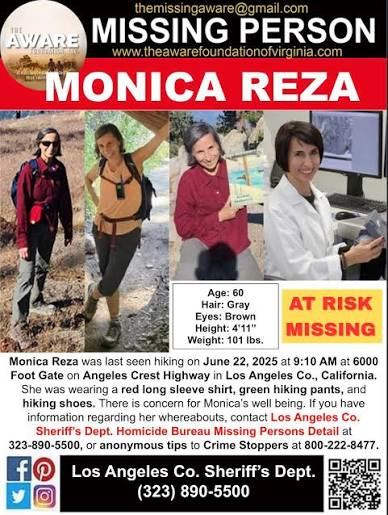
Monica Jacinto Reza disappeared June 22, 2025. The initial search, dogs, drones, air support, wrapped after about a week with no trace beyond a beanie found six hundred feet down a ravine. Her case moved to the Los Angeles County Sheriff's Homicide Bureau's Missing Persons Unit, which is where cases go when they aren't solved, not where they go to be forgotten. For the next nine months, as far as the public record shows, nothing happened. No press follow-up. No renewed search. Just a Facebook group of volunteers keeping her name alive on their own time.
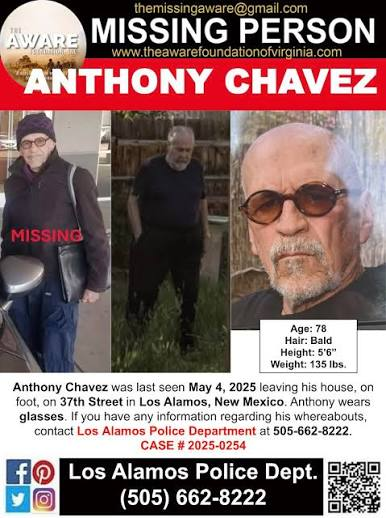
Anthony Chavez, a 78-year-old retired Los Alamos foreman, walked away from his home on foot in May 2025 and left his wallet and keys behind. Melissa Casias, an administrative assistant at Los Alamos, disappeared in June 2025; her remains were found in Carson National Forest almost a year later, in May 2026. Steven Garcia, a property custodian at the Kansas City National Security Campus who oversaw classified nuclear-weapons components, walked out of his Albuquerque home in August 2025 carrying a handgun and has not been seen since.
None of these cases individually made national news. Each one got a few local stories and then went quiet, the way most missing-persons cases do.
Then, on February 27, 2026, William Neil McCasland, a retired Air Force major general who had once commanded the Air Force Research Laboratory at Wright-Patterson, the same base linked for decades to Roswell lore, walked out of his own Albuquerque home. His phone, his glasses, his wearable device, all left behind. His wife told a 911 dispatcher she believed he had planned not to be found.
That was the trigger. Online communities connected McCasland to Reza within days, since Reza's alloy research had been funded under a program McCasland once oversaw. By March, journalists picked it up. By April, the story detonated: NewsNation, the New York Post, CNN, CBS, Fox. A reporter asked White House Press Secretary Karoline Leavitt about it directly. Trump commented on it. The House Oversight Committee sent the FBI a formal letter on April 20 demanding a briefing by April 27. The FBI announced it was "spearheading" a multi-agency review with the Department of Energy and the Department of Defense.
For about three weeks, this was a major national story.
WHERE IT WENT
Two things happened next, and they happened to be the two things that let everyone stop paying attention.
On April 29, 2026, the FBI and the U.S. Attorney's Office for Massachusetts announced they had conclusively solved the killing of MIT plasma physicist Nuno Loureiro, one of the names on every version of the list. A named gunman, no connection to terrorism, no connection to anything larger.
One thread, cut clean.
A month later, on May 31, Melissa Casias's remains were identified in Carson National Forest. State police said the evidence pointed to her having left on her own, under financial stress. Another thread, resolved, not fitting the pattern anyone wanted.
Between those two developments, the story lost its two most dramatic, most citable data points. What was left, four people still actually missing, with no bodies, no suspects, no resolution, is a genuinely harder story to keep running. It doesn't have a clean ending. It doesn't have a villain. It just has silence, which turns out to be much less clickable than a murder.
I looked for the follow-up myself. I searched every major outlet that covered this story at its peak. NewsNation, CBS, CNN, the Los Angeles Times, USA Today. Nothing dated later than roughly the early summer of 2026. The most recent reference I could find on McCasland's case at all was a case-tracking database, not a news outlet, dated September 13, simply repeating facts that were already three months old. The FBI's own April announcement that it would "spearhead" this investigation has produced, as far as any public record shows, zero public updates in five months.
Monica Reza's family told Los Angeles Magazine, on the record, that federal investigators have never once contacted them, despite her name being specifically listed in the White House's own announced probe. They learned about General McCasland the same way the rest of the country did.
That is not a rumor. That is a named family member, quoted directly, describing federal silence toward a case the federal government itself said it was reviewing.
WHY THIS MATTERS MORE THAN ANY THEORY
I am not going to tell you these four cases are connected by anything beyond geography and the terrible coincidence of timing. I've spent real time checking the theories that circulate around them, and most don't hold up under a records request. What holds up, every time, is much simpler and somehow more disturbing: American journalism has a six-week attention span for a missing person, and once that window closes, the case does not get reopened by a fresh editor looking for a hook. It just stops.
Four people, two of them with documented ties to classified defense research, are still gone. Their families are still waiting. And unless something new breaks, whether that's a body, an arrest, or a journalist willing to file a public records request instead of writing another explainer, nobody is coming back to check.
I am.
If you have information on any of these cases, the agencies below are still actively investigating, whatever the news cycle suggests:
Monica Jacinto Reza — LASD Homicide Bureau Missing Persons Unit, (323) 890-5500
William Neil McCasland — Bernalillo County Sheriff's Office, (505) 468-7134
Anthony Chavez — Los Alamos Police Department, (505) 662-8222
Steven Abel Garcia — Albuquerque Police Department, (505) 242-2677


Comments