They Wore God's Face
Updated: May 13
On corporal punishment, silence, and the children the Catholic Church forgot to protect from its women
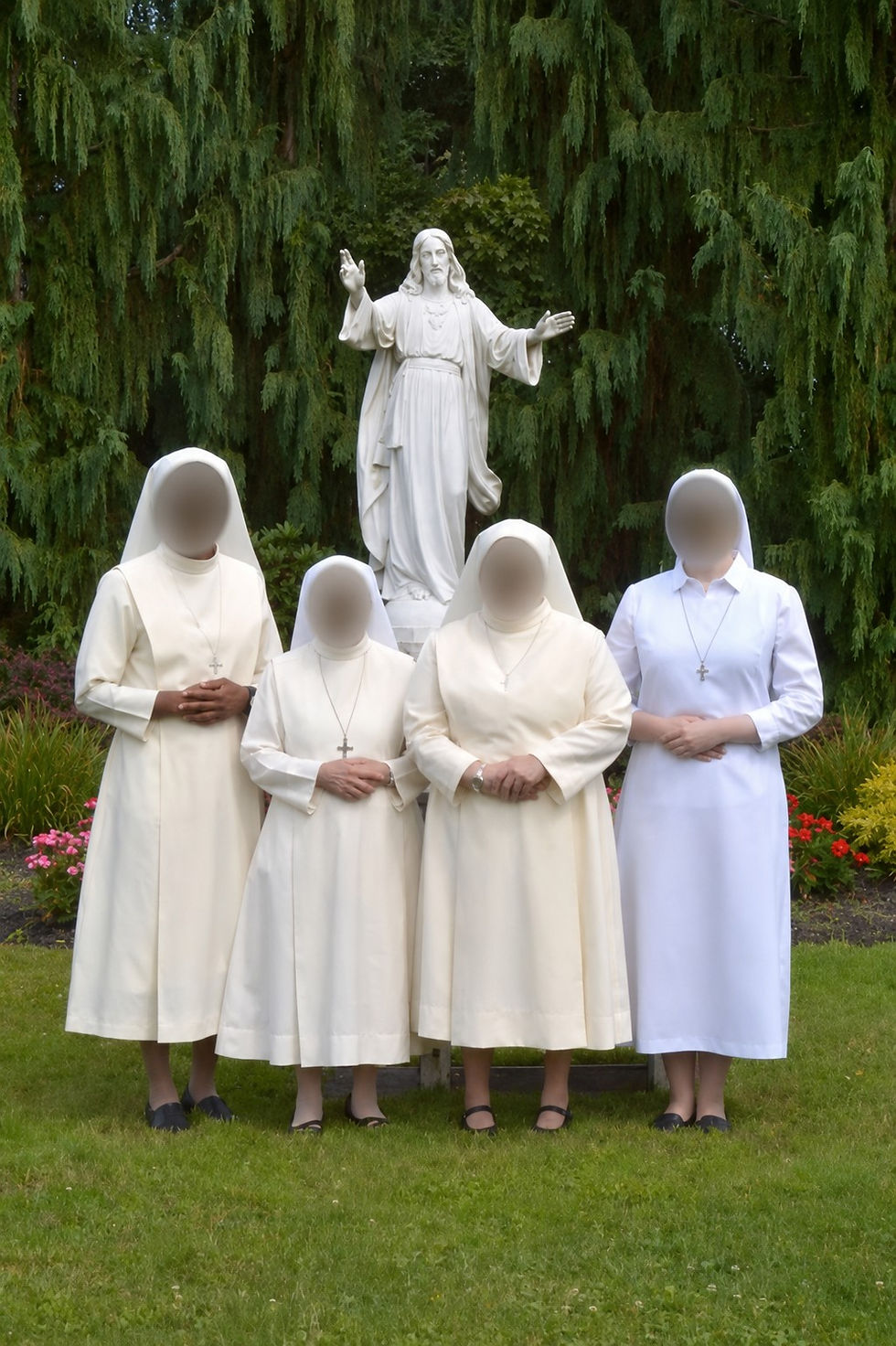
There is a particular kind of fear that lives in the body long after the mind has tried to reason it away. It is not the abstract fear of something that might happen. It is the residue of something that already did. For those of us who sat in the small wooden desks of Catholic school classrooms in the latter half of the twentieth century, that fear often has a very specific shape. It wears a black or white habit. It holds a ruler. And it answers to Sister.
I want to be precise about something before I go further. This is not an essay about God. It is not an argument against faith, or a prosecution of Catholicism as a belief system, or a dismissal of the quiet and genuine devotion that millions of people carry with them to this day. Faith can be a shelter. What happened in those classrooms was the opposite of shelter. It was power wearing the face of holiness, and it was directed at children who had no language yet for what was being done to them.
I was one of those children. My experiences were in the 1980s. Not the 1940s. Not some distant era we can safely bracket as a different time. The Reagan years. The era of Saturday morning cartoons and the very public idea that children mattered. And still, in a classroom not far from where I grew up, a nun duct-taped a child's mouth shut. Duct-taped children to their chairs. I watched it happen. I watched a child thrown into a garbage can. I watched heads brought into contact with concrete walls in a way that had nothing to do with accident and everything to do with fury. I watched a boy get turned over while he was sitting in his desk because he couldn’t answer a math problem correctly. You always knew who got in trouble in one teacher’s class because their shirt would be stretched out around the neck at the end of the day. Have you ever written “Silence is Golden” 500 times after a boy misbehaved in an assembly? I have.
In first grade, I was not permitted to use the restroom. I urinated myself as I faced the corner. Everyone saw. I sat in that for the remainder of the school day. The lesson I was being taught was not about bladder control. It was about who owned my body inside those walls. The answer was not me.
Our principal kept a paddle in his office. If you were sent to him, you were paddled. This was not a secret. It was, in its own way, a system. Systematic, administered, normalized. Abuse dressed in the language of discipline has always had that quality: it organizes itself, creates procedures, and maintains the appearance of its own legitimacy.

"The fury was always disproportionate to the crime. That is the detail that stays with me. Not the paddle, not the tape. The disproportion."
The Stories Go Further Back
The accounts that have come to me from others reach further back, and the further back they reach, the starker the theology becomes. In the 1960s, a woman I know had water poured over her head because the nuns determined she had used too much hairspray. The hair itself was the transgression. The body, again, was the site of punishment and the instrument of shame.
Then there is my grandfather. He was left-handed. In the 1940s, the sisters who taught him decided this was unacceptable. Not merely inconvenient. Unacceptable in a theological sense. Of the devil, the phrase went. So they hit his left hand. Repeatedly. And my grandfather developed a stutter that he carried with him for the rest of his life.
A stutter that stayed. That is what I want you to sit with. Not the hitting, though the hitting was real. The permanent remaking of a person's voice. The way a child's speech can be broken and never fully repaired by someone who believed they were doing the Lord's work.
He was a small boy who held his pencil in his left hand. He left that school speaking differently than he arrived. Nobody was held accountable. Nobody was asked to explain. The institution absorbed it the way institutions absorb so many things: quietly, completely, and without apology. I never actually got to meet him, as he took his life in 1970.
The Shadow Behind the Priest Story
The public conversation about Catholic abuse has centered almost exclusively on priests. That conversation is necessary and urgent and unfinished. But it has cast a long shadow over a parallel story that is only beginning to be told. The nuns were there too. In many cases, the nuns were the daily face of institutional power for Catholic children. They were the ones in the classrooms, the orphanages, the corridors. They were the ones with unlimited access and zero accountability, insulated by their vocations from the kind of scrutiny that might have protected us.
Researchers who have examined this history describe a consistent pattern: punishment that shifted with mood, fury disproportionate to any infraction, public humiliation wielded as a tool of control, and a total power differential that made complaint not just futile but dangerous. The child who reported abuse became a target for more. The door closed. The class watched. Nobody came.
Kim Michele Richardson wrote the first book in the United States to document institutionalized abuse by Catholic nuns, and it took until 2009 to exist. Christine Kenneally's investigative work on St. Joseph's orphanage in Vermont was viewed six million times when it was published in 2018, which tells you something about how many people had been waiting for someone to say it plainly. The hunger for this reckoning is real. The documentation is still incomplete. The survivors are still alive.
A Record, Not a Verdict
I am not writing this to relitigate the past in a vacuum. I am writing it because the past is not a vacuum. It is a set of rooms that many of us are still living in, at least in part. The child who wet herself at her desk did not simply grow up and leave that behind. The boy with the stutter carried it into every conversation he ever had for the rest of his life. Trauma is not metaphor. It is physiology. It is the nervous system learning a lesson it was never supposed to learn, and then holding it as truth.
What I am building toward, with this essay and with what follows it, is a record. Not an indictment of faith. A record of what happened to children in the name of an institution that claimed authority over their bodies, their behavior, their souls, and their silence. That institution is not the same as God. But it used God as cover, and we should be honest about that.
The habit was a uniform. The classroom was a closed room. The children had nowhere to go.
This Is Only the Beginning
I am collecting stories. If you attended Catholic school in any decade and carry something you have never been asked to put into words, I want to hear from you. Your name does not have to appear anywhere. Your experience does not have to fit a particular shape. What happened is enough.
This project is growing into something larger: a podcast episode, an oral history, and possibly a book. Every account matters. Every account is evidence that this was not isolated, not a few bad actors, not ancient history.
Reach out at fearandwinepod@gmail.com or find us at fearandwine.com. You will be heard. You can also comment here, but I know these stories can be very private for many.
Sources
Richardson, Kim Michele. The Unbreakable Child. 2009. The first book in the United States to document institutionalized physical and emotional abuse of children by Catholic nuns, and the first-ever legal settlement paid by Roman Catholic nuns in the U.S. Goodreads listing
Kenneally, Christine. Ghosts of the Orphanage: A Story of Mysterious Deaths, a Conspiracy of Silence, and a Search for Justice. PublicAffairs, 2023. Expanded from her 2018 BuzzFeed News investigation into abuse at St. Joseph's Catholic orphanage in Burlington, Vermont, which was viewed more than six million times. Original BuzzFeed News investigation
Williams, Pete. "There's Another Skeleton in the Catholic Church's Closet." Medium, July 28, 2021. Discusses the difficulty of centering physical nun abuse in public discourse given the normalization of corporal punishment during the era. Read the article
Opening Doors to Safer and More Inclusive Schools. "Invisible Voices: Victims of Corporal Punishment in the 20th Century Catholic School System." September 2, 2022. Research compilation drawing on sociology journals and alumni interviews documenting patterns of physical and psychological abuse by nuns in U.S. and Canadian Catholic schools. Read the research
Wikipedia. "Abuse Scandal in the Sisters of Mercy." Documents institutional abuse findings related to the Sisters of Mercy congregation across multiple countries. Read the entry
Commonweal Magazine. "Abuse at Catholic Orphanages." June 29, 2023. Review and analysis of Kenneally's book, with additional firsthand context from a writer who attended Catholic school in New Jersey. Read the piece


Comments