French Horror Part 1: Red Rooms and the Horror of Being Watched

Updated: May 7
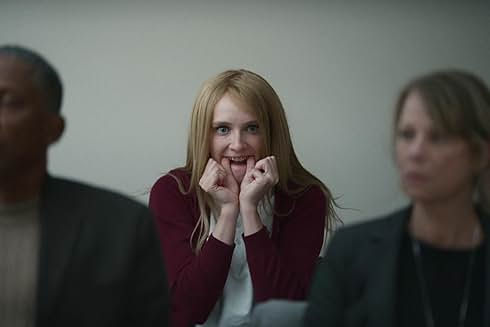
If you want to understand why French horror hits differently than anything Hollywood is currently producing, start with Red Rooms. Written and directed by Pascal Plante, this 2023 French-Canadian psychological thriller is one of the most unsettling and intellectually precise horror films of the last decade, and it doesn't need a single jump scare to get there. It is a film about obsession, voyeurism, and the quietly horrifying culture that has grown up around true crime, and it will make you deeply uncomfortable in ways you won't fully be able to articulate for days.
Here at Fear & Wine, French horror is one of Kelli's absolute favorite subgenres, and honestly, Red Rooms is exactly the kind of film that explains why. We covered it on the podcast, and below is our full breakdown of what makes this film so remarkable and so necessary.
What is Red Rooms about?
Set in Montreal, Red Rooms follows Kelly-Anne, a beautiful and enigmatic fashion model played by Juliette Gariépy in a performance that is genuinely one of the best in recent horror. Kelly-Anne has been attending the trial of Ludovic Chevalier, a man accused of kidnapping, torturing, and murdering three teenage girls, filming each killing in a so-called "red room," a dark web livestream where paying viewers watched the murders in real time.
The case has attracted a media circus, including Clementine, a younger woman who has convinced herself that Chevalier is innocent and attends the trial as something closer to a fan. Kelly-Anne and Clementine form an uneasy connection, and as the trial progresses, Kelly-Anne's interest in the case deepens into something far darker and more personal than simple morbid curiosity.
What makes the film so effective is what it withholds. The murders happened. The videos exist. We are told in explicit detail what is on them. But Plante almost never shows them. The horror lives entirely in what we know is there but cannot see, which is the most precise possible metaphor for how the internet has rewired our relationship to violence and suffering.
French horror and the art of restraint
One of the defining qualities of French horror as a genre, from the New French Extremity movement of the early 2000s through to contemporary films like Red Rooms, is its willingness to use restraint as a weapon. Where American horror often equates intensity with visibility, French horror understands that the most disturbing thing you can do is make the audience's imagination do the work.
Red Rooms is a masterclass in this. The film's opening sequence is a long, fluid single take through a courtroom, establishing the geography, the players, and the stakes with the patience of a filmmaker who knows exactly what she is building toward. By the time the film enters its thriller mechanics, you are already fully inside its world, and the dread is entirely yours, built from what you have been told rather than what you have been shown.
The visual vocabulary of the film is cold, precise, and beautiful in the way that surveillance footage is beautiful, functional and unnerving at once. Cinematographer Itai Ishi-Kov shoots Kelly-Anne in a way that constantly makes you feel like you are watching her without her knowledge, which is exactly the point. In a film about voyeurism, everyone is both watcher and watched.
The true crime industry on trial
The sharpest thing about Red Rooms is its diagnosis of the true crime entertainment complex. The film is not subtle about this. Clementine represents one pole of true crime fandom, the person who has romanticized the killer so thoroughly that she has lost the capacity to see the victims as human beings. Kelly-Anne represents something harder to name and more disturbing to sit with.
The contrast between the two women is the film's central argument. Both are obsessed. Both have organized their lives around this trial. But their obsessions point in different directions, and Plante uses that gap to ask a question the true crime industry would rather not answer: what does it mean to consume violent death as entertainment, and what does that consumption do to us over time?
The film came out as snuff film content, torture porn, and real violence were becoming increasingly accessible and increasingly normalized in online spaces. That timing is not incidental. Red Rooms is specifically about what happens to human empathy when it is routed through a screen and a subscription model.
Juliette Gariépy and the performance that holds it all together
None of this works without Gariépy's performance, which is extraordinary in its stillness. Kelly-Anne is one of the most opaque protagonists in recent horror, and the film asks you to sit with that opacity for nearly two hours without offering easy resolution. Gariépy never tips her hand. Every scene, you are reading her face for information she refuses to give, which puts you in exactly the same position as the courtroom spectators watching Chevalier, trying to find the monster in a face that gives nothing away.
It is a performance that functions as a structural element of the film's horror rather than just a character portrayal, and it is the kind of work that French horror, and specifically this generation of French-language filmmakers, seems to produce with remarkable consistency.
We talked about all of this on Fear & Wine
We went deep on Red Rooms on the podcast, covering everything from the film's technique and restraint to the true crime culture it is dissecting, the dark web as a horror setting, and why this film lands so much harder than most American horror releases of the same period. If psychological horror and the kind of film that makes you think for days afterward is your thing, this episode is for you.
And when you are done, head straight to Part 2 of our French Horror series, where we cover MadS, a film shot in one continuous take that turns a drug-fueled party night into an apocalyptic fever dream. Same subgenre, completely different energy, equally essential.



Comments